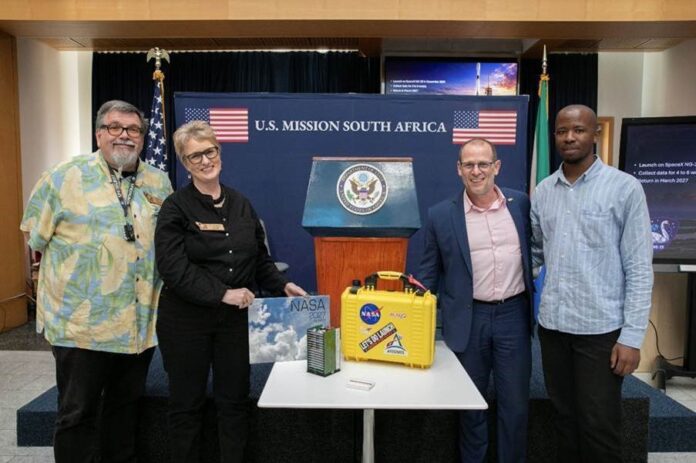
South Africa’s favourite homegrown brew is officially heading for the stars. The ambitious Rooibos in Space project reached a thrilling milestone this week following a high-profile farewell ceremony hosted by Allison Areias, US Consul General in Cape Town. The event celebrated a shipment of South African school and university science experiments bound for the United States—accompanied by a very special cargo of indigenous seeds.
Prepping 17,000 Seeds for Low Earth Orbit
A precisely measured consignment of 17,346 Rooibos seeds, weighing just 74.2 grams, is en route to Voyager Technologies in Texas. There, experts will prepare the experiment for spaceflight inside a specialized Nanolab—a compact, plug-and-play research module designed to protect the seeds during travel while exposing them to the intense microgravity and radiation of low Earth orbit.
To maximize research outcomes, seed technician Cyril Ngqwala divided the batch into three prepared sets: untreated, scarified, and scarified with a protective agricultural coating.
“Working with the seeds from preparation through to assembling the Nanolab has been an incredible experience,” says Ngqwala, highlighting the rare opportunity to blend traditional Rooibos seed expertise with cutting-edge space science. “We have prepared the seeds in different conditions so that, when they return, we can compare their performance with seeds that have remained on Earth.”
A Milestone Mission to the Space Station
The Rooibos Nanolab is slated to launch to the International Space Station (ISS) aboard the Cygnus NG-25 commercial resupply spacecraft, with lift-off expected between December 2026 and January 2027 following recent adjustments to NASA and Voyager flight schedules.
Conceived by the South African Rooibos Council (SARC) in collaboration with MaxIQ Space, the mission marks the first time an indigenous South African plant seed will be sent into space for research of this kind.
“This is an exciting milestone for Rooibos and for South Africans who have followed this project from the beginning,” says Dawie de Villiers, Director of the SARC. “The scientific objective is to explore what will happen to the Rooibos seeds when they are exposed to conditions beyond Earth, opening up new opportunities to learn more about this uniquely South African plant.”
Inspiring the Next Generation of Scientists
After spending four to six weeks in orbit, the space-faring seeds will return home to Earth for a hands-on, 18-month agricultural study. Researchers will team up with Parklands College and schools in the Cederberg region—the natural, harsh climate where Rooibos uniquely thrives—to plant the exposed seeds alongside un-flown control seeds. Participating students will directly measure and analyze differences in germination rates, growth patterns, and overall plant development.
STEM education and youth participation sit at the very heart of the initiative, which has already featured classroom engagement programs and a national Mission Patch competition for young innovators aged 12 to 18. By involving local learners directly in post-flight research, the project connects South Africa’s rich botanical heritage with the future of global space exploration.