In Somerset West, a community surrounded by the soaring Helderberg mountains and swept by sea breezes, healing has always been tied to a sense of place. Yet, for many local residents navigating the long road back from a stroke, major surgery, or severe injury, that recovery journey has historically meant leaving the region or spending weeks in rigid acute hospital wards.
The opening of the Intercare Somerset West Physical Rehabilitation Hospital marks a significant shift in how healthcare is delivered in the valley. Located on the upper level of the Vergelegen Plein Shopping Centre, this new 34-bed facility introduces a restorative, function-first model of care designed specifically to help patients regain their independence close to home.
Bridging the Gap: Beyond Emergency Care
Somerset West and the broader Helderberg basin are well-served by acute hospitals equipped for emergency interventions and major surgeries. However, a systemic gap often opens up once a patient becomes medically stable. Traditional acute hospital wards are designed for bed rest, clinical monitoring, and rapid turnarounds—not the active, daily physical therapy needed to rebuild motor skills, strength, and mobility.
Previously, patients recovering from complex conditions such as spinal cord injuries, stroke complications, or joint replacements faced an uncomfortable compromise: remain in standard acute hospital beds where active rehabilitation is limited, or endure tiring daily journeys to specialized rehabilitation centers in Cape Town.
By establishing a dedicated sub-acute facility locally, the hospital solves a long-standing logistical challenge for Helderberg families. Rather than spending critical recovery weeks far from their support networks, patients can now transition smoothly into an environment tailored entirely to functional recovery within their own community.
A Design for Living, Not Just Resting
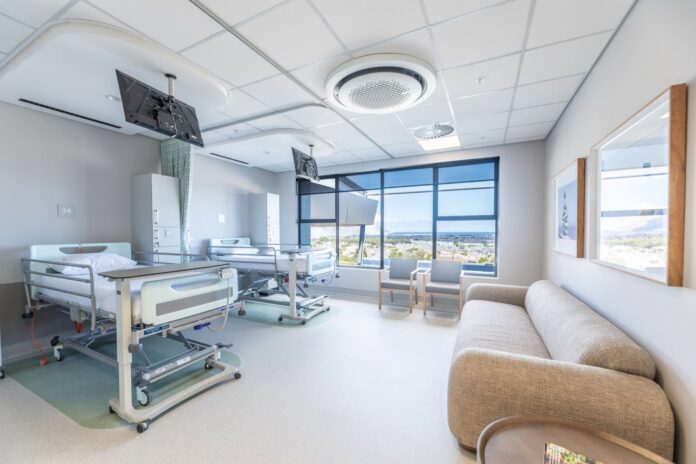
Stepping into the upper-level facility feels distinctly different from entering a conventional medical ward. Here, spatial design, natural light, and clinical philosophy are aligned around active rehabilitation rather than static bed rest.
Healing Through Routine and Connection
From the moment patients arrive, the focus shifts away from traditional sickness roles toward active participation. Hospital gowns are set aside in favor of regular daywear and athletic shoes. Instead of eating meals alone in bed, patients are encouraged to gather in open, communal dining areas to socialise and practice mobility.
Large windows throughout the facility frame expansive views stretching across the Helderberg basin toward False Bay, using natural light and open horizon lines to support psychological well-being during what can often be a daunting rehabilitation process.
Purpose-Built Recovery Spaces
The hospital’s layout is engineered to simulate real-world physical challenges:
Therapy Gyms: Dedicated occupational and physiotherapy spaces equipped for progressive mobility and strength training.
Hydrotherapy Pool: An on-site heated pool providing low-impact buoyant resistance therapy for joint and neurological recovery.
Real-World Simulation: An Activities of Daily Living (ADL) simulation kitchen, allowing individuals to practice everyday household tasks—such as pouring a drink or navigating kitchen counters—before returning home.
Cognitive Spaces: Specialized rehabilitation rooms designed to help stroke and brain injury survivors restore memory, focus, and coordination.
Collaborative Clinical Care
Clinical management at the hospital operates in strategic partnership with Rita Henn & Partners, specialized therapy practitioners in physical rehabilitation. Led by Clinical Head Dr. Dale Cilliers and Rehabilitation Doctor Dr. Fred Ferreira, an interdisciplinary team delivers 14 specialized programs spanning neurological care, orthopaedics, cardiac recovery, and post-amputation rehabilitation.
A Fresh Approach to Regional Healthcare
As the Helderberg region continues to grow and age, the demand for specialized, post-acute care is becoming increasingly vital. By shifting the focus of recovery from static bed rest to active, dignity-centred routine, the new hospital offers local families a meaningful bridge between major medical crises and a confident return to daily life.