
The South African Reserve Bank’s Monetary Policy Committee (MPC) decision to keep the repo rate unchanged brings welcome relief to households across the country. According to Dr Andrew Golding, chief executive of the Pam Golding Property group, the pause provides vital breathing room for consumers managing debt—particularly mortgage holders, vehicle finance repayments, and store credit.
While living costs like electricity tariffs and municipal services continue to weigh on households, Dr Golding notes that the decision offers greater certainty and stability for consumers and businesses at a time of heightened global economic uncertainty.
Navigating the Petrol Price Rollercoaster
For everyday consumers, the broader inflation story is often written at the petrol station. Motorists have had to navigate an exhausting financial rollercoaster in recent months—watching prices surge to record peaks before enjoying temporary cuts.
Dr Golding points out that rising global oil prices—climbing above $90 a barrel—alongside currency pressures and Middle East tensions have made the inflation outlook far more challenging. Because petrol fluctuations directly push up transport, food, and retail prices, this volatility remains a central concern for policymakers and monthly household budgets alike.
Why Policymakers Opted for Caution
The Reserve Bank faced a delicate task following June Consumer Price Index (CPI) data, which rose to a higher-than-expected 5%—up from 4.5% in May. Core inflation also edged up to 4.1%, exceeding the Reserve Bank’s preferred target range.
Despite these underlying inflationary pressures, policymakers elected to hold rates steady. Dr Golding highlights that this decision demonstrates an important effort by the SARB to balance inflation risks with the practical need to support economic activity and household finances.
Residential Property Shows Strong Momentum
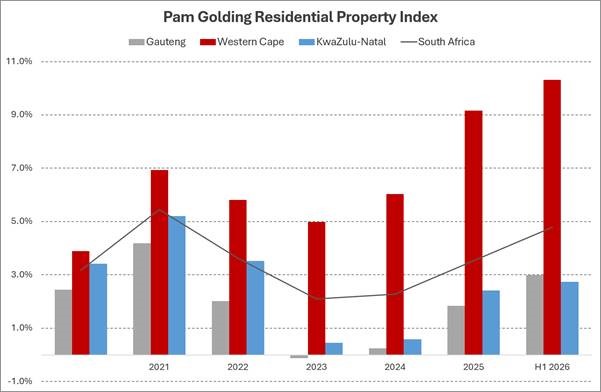
Despite broader economic headwinds, South Africa’s residential real estate market continues to demonstrate remarkable resilience. According to the Pam Golding Residential Property Index, national house price growth reached 5.1% in June, averaging 4.8% during the first half of 2026—the strongest national performance seen since the post-pandemic recovery in 2021.
Regional performance reveals distinct market leaders:
- Western Cape Leadership: The province continues to outpace the rest of the country by an increasing margin, averaging 10.3% price growth in H1 2026.
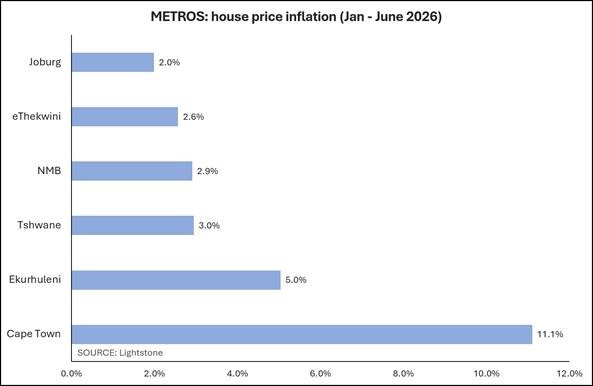
- Cape Town Performance: Cape Town topped all major metropolitan markets with an average house price inflation of 11.1%.
- Gauteng & KZN: Recorded more modest growth at 3.0% and 2.8% respectively.
Dr Golding also highlights that non-coastal areas have gained steady momentum, outperforming coastal price growth for four consecutive months, while freehold property growth (6.3%) continues to outpace sectional title units (4.9%).
Banks Support First-Time Buyers
Lending conditions remain exceptionally favorable for prospective homeowners. Data from ooba Home Loans shows that first-time buyer applications rebounded to 48.8% in June, with demand surging in more affordable regions such as the Free State and southern/eastern Gauteng.
Commercial banks maintain a strong appetite for mortgage lending, with national approval rates averaging nearly 84%—and reaching 91.2% for pre-qualified applicants. With banks granting 100% home loans on 56.9% of applications, barriers to entry for new buyers remain refreshingly low.