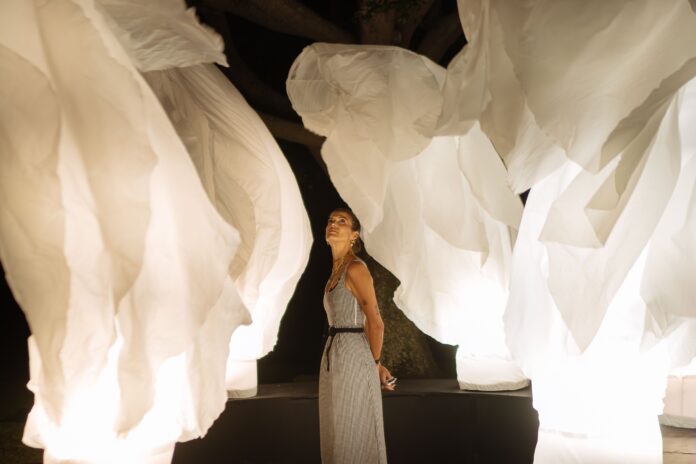
As night settles over Stellenbosch, the familiar contours of vineyard, river and tree line begin to shift. From 6 March to 6 April 2026, Spier Light Art returns for its eighth edition, transforming Spier Wine Farm into a nocturnal landscape of contemporary art. After sunset, works glow, shimmer and hum across the grounds, inviting visitors to experience light as both medium and message.
No map, no rush
Unlike a conventional exhibition, Spier Light Art has no fixed route and no prescribed order. Visitors move through the farm at night, encountering artworks along winding paths, riverbanks and open spaces. Curator Vaughn Sadie describes the experience as deliberately open-ended. “The exhibition invites audiences to immerse themselves in the sensual and ephemeral interplay of light and sound,” he says, “allowing curiosity and intrigue to guide their journey.”
Light as a way of seeing
Curated by Sadie and Jay Pather, the 2026 edition brings together works by 21 South African artists selected through an open call. While there is no single theme, the artists were invited to explore light in all its conceptual, cultural and socio-political dimensions. “At its core, light art is more than illumination,” Sadie notes. “It is a lens through which we perceive, reflect and question the world.”
Some works speak directly, using neon text and familiar language to capture everyday frustrations and humour. Others are quieter, abstract or technological, exploring perception, infrastructure and the unseen forces that shape daily life. Often, works are intuitively clustered in the landscape, setting up conversations through scale, material or mood.
Memory, inequality and the present moment
Shared concerns emerge organically across the exhibition. Pather points to a strong collective interest in memory and in how the past continues to inform the present. Questions of environmental crisis, social inequality and post-apartheid realities recur, shaped by South Africa’s specific histories and conditions.
Kenneth Shandu’s When the Sky Falls reflects on recurring floods and neglected service delivery, using illuminated umbrellas and the sound of rain as symbols of vulnerability and resilience. Florian Bach’s Spill floods a riverbank with industrial lamps, transforming brightness into a form of intrusion and raising questions about surveillance, control and ecological impact. Joe Turpin’s neon EISH captures the contradictions of post-1994 life, prompting viewers to reflect on the small moments that carry deeper social weight.
Interspersed among the more confronting works are installations that create moments of rest. Positioned between trees or along the Eerste River, some artworks invite visitors to slow down and take in the surroundings. In a world dominated by screens and artificial glare, these gentle interventions offer a rare chance to experience light in its most elemental form — shared with strangers, moving quietly through the dark.
Local voices, global dialogue
The exhibition continues its international exchange programme this year, welcoming Swiss artists Florian Bach and Kerim Seiler. Their site-specific projects respond to the South African context, opening a dialogue between local and global perspectives on contemporary light art.
Spier Light Art 2026 is less about spectacle than attention. It asks visitors to step away from the familiar, to wander without agenda, and to experience light as something that can hold memory, critique and wonder — long after the farm returns to darkness.