It was a turn-of-the-century version of the dot-com boom. The promise of a revolutionary new technology was changing the way people imagined the future. And there was a race to see who could do it first. It was the end of the nineteenth century, and the new technology was the airplane. One of the best-known men in the field was Samuel Pierpont Langley.
Like many other inventors of his day, he was attempting to build the world’s first heavier-than-air flying machine. The goal was to be the first to achieve machine-powered, controlled, manned flight. The good news was Langley had all the right ingredients for the enormous task; he had, what most would define as, the recipe for success.
What was Langley’s Motivation?
Langley had a bold goal, but he didn’t have a clear sense of WHY. His purpose for wanting to build the plane was defined in terms of WHAT he was doing and WHAT he could get. He had a passion for aeronautics since a very young age, but he did not have a cause to champion. More than anything else, Langley wanted to be first. He wanted to be rich and famous. That was his driving motivation.
Although already well regarded in his own field, he craved the kind of fame of a Thomas Edison or Alexander Graham Bell, the kind that comes only with inventing something big. Langley saw the airplane as his ticket to fame and fortune. He was smart and motivated, had plenty of cash, and he had the best people and ideal market conditions.
The Wright brothers had a dream
A few hundred miles away in Dayton, Ohio, Orville and Wilbur Wright were also building a flying machine. Unlike Langley, the Wright brothers did not have the recipe for success. Worse, they seemed to have the recipe for failure. There was no funding for their venture. No government grants. No high-level connections. The Wright brothers funded their dream with the proceeds from their bicycle shop. Not a single person working on the team, including Orville and Wilbur, had a college education; some did not even finish high school. What the Wright brothers were doing wasn’t any different from Langley. But the Wright brothers did have something very special.
They had a dream. They knew WHY it was important to build this thing. Furthermore, they believed that if they could figure out this flying machine, it would change the world. They imagined the benefits to everyone else if they were successful.
Orville and Wilbur preached what they believed and inspired others in the community to join them in their cause. The proof of their commitment was self-evident. With failure after failure, most would have given up, but not the Wright brothers’ team. The team was so inspired that no matter how many setbacks they suffered, they would show up for more. Every time the Wright brothers went out to make a test flight, they would take five sets of parts with them.
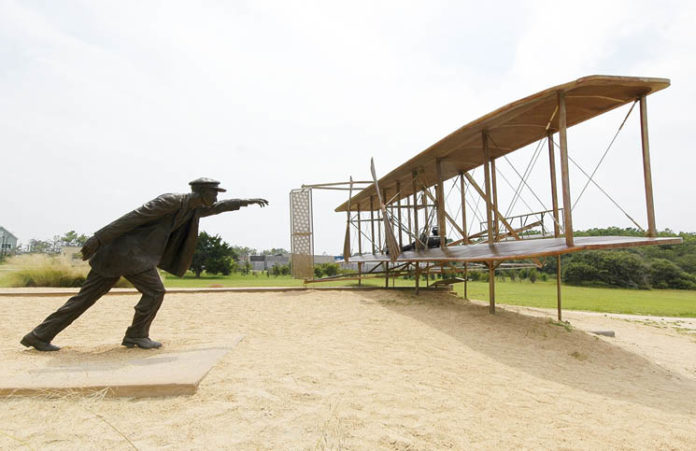
Then it happened. On December 17, 1903, on a field in Kitty Hawk, North Carolina, the Wright brothers took to the sky. A fifty-nine-second flight at an altitude of 120 feet at the speed of a jog was all it took to usher in a new technology that would change the world.
What Langley and the Wright brothers were trying to create was the same; both were building the same product, were highly motivated, had a strong work ethic and both had keen scientific minds. What the Wright brothers’ team had that Langley didn’t have was inspiration. One was motivated by the prospect of fame and wealth, the other by a belief. The Wright brothers excited the human spirit of those around them. Langley paid for talent to help him get rich and famous.
The Wright brothers started with WHY. Further proof Langley was motivated by WHAT: a short time after Orville and Wilbur took flight, Langley quit and got out of the business.
What is your WHY?
How great leaders inspire anyone to take Action – From the book, Start with Why by Simon Sinek