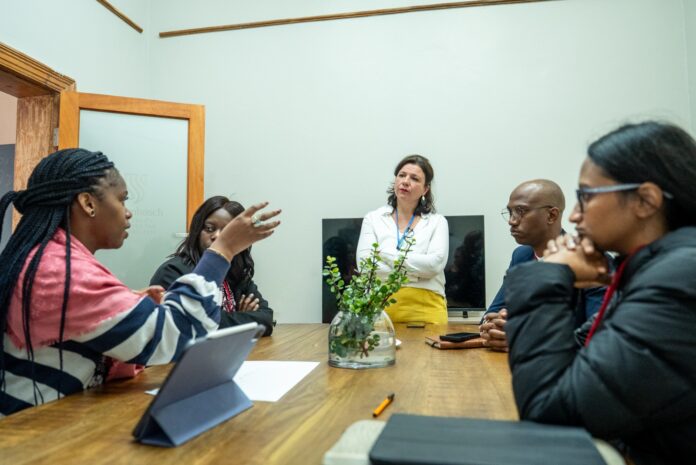
Impact Hub, a global network with over 130 hubs in 70 countries, has officially launched in the Cape Winelands, marking the first hub in the Western Cape and the second in South Africa. Its mission is to create an enabling environment for entrepreneurs who want to drive positive change, connecting them with government, academia, business, and civil society to co-develop solutions to South Africa’s pressing challenges.
Community-Centered Approach
Unlike traditional incubators focused on high-growth “unicorn” businesses, Impact Hub Cape Winelands emphasises community-owned impact ventures. CEO Marli Goussard stresses that “those closest to the societal challenges are also closest to the solutions.” By equipping and supporting local entrepreneurs, the hub ensures that communities not only design but also own their solutions—benefiting economically, not just socially. This approach strengthens trust, fosters empowerment, and builds sustainable change rooted in local knowledge.
Why the Cape Winelands?
The Cape Winelands region highlights South Africa’s stark inequality. Despite being home to world-class institutions and affluent towns such as Stellenbosch, Paarl, and Franschhoek, over half of its 900,000 residents live below the poverty line. South Africa ranks among the most unequal societies globally, with the top 10% holding 86% of wealth. In the Winelands, apartheid-era dynamics still shape economic disparities, making it a critical testing ground for inclusive growth.
The region’s unique mix—wealth alongside poverty, academic excellence alongside under-resourced communities—creates both urgency and opportunity. By harnessing these contrasts, the hub seeks to pioneer new models for equitable, community-driven development.
Early Projects and Future Focus
Though newly launched, Impact Hub Cape Winelands is already partnering with Fix Forward and Stellenbosch University on a circular economy project. Small building contractors are being trained to transform construction and mining waste into alternatives to cement, creating livelihoods while advancing environmental sustainability.
Looking ahead, the hub plans to prioritise community healthcare. One initiative may involve training local health workers as microentrepreneurs, equipped with diagnostic tools to provide affordable healthcare directly in their neighbourhoods. Such models illustrate how economic opportunity can merge with social good.
Creating an “Impact Ecosystem”
The hub is not working in isolation—it is actively inviting partnerships across multiple sectors:
-
Government: shaping policies that enable local entrepreneurs.
-
Universities: embedding impact innovation in research and teaching.
-
Non-profits: developing income-generating opportunities in the communities they serve.
-
Businesses: supporting local suppliers and aligning B-BBEE spending with enterprise development.
-
Entrepreneurs and students: joining training and networks.
-
Funders: providing patient capital and measuring real outcomes.
Plans are also underway for a dedicated Impact Hub space in Stellenbosch to house incubation, collaboration, and community-building efforts.
Why It Matters
The significance of Impact Hub Cape Winelands lies in its holistic, locally anchored approach. By centering entrepreneurship in community ownership, it shifts development from top-down charity or external intervention to empowerment and economic inclusion. In one of the world’s most unequal societies, this model has the potential to address poverty and inequality at their roots while fostering dignity, resilience, and innovation.
Ultimately, success will be measured not in billion-dollar startups but in a thriving ecosystem of small, sustainable, locally owned ventures that transform the Cape Winelands—and set an example for inclusive growth across South Africa.