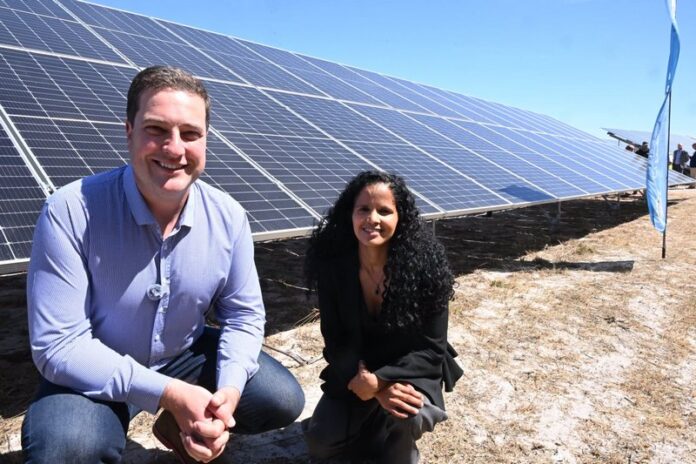
The launch of the R220-million Helderhoop Solar and Storage Power Plant in Atlantis represents a milestone in hybrid power innovation. While constructed and owned by local government, the significance of this facility extends far beyond municipal administration. It serves as a practical proof of concept for local self-reliance, energy market liberalisation, and localized economic renewal in an era defined by grid instability.
Hybrid Power Innovation Drives Municipal Autonomy
Hybrid power innovation allows local governments to disrupt traditional electricity supply models. Historically, South African municipalities have operated strictly as distributors—buying electricity wholesale from national utility Eskom and reselling it to end-users. Helderhoop breaks this centralized dependency by establishing the country’s first metro-built and metro-owned hybrid generation asset.
By pairing 12,850 solar panels across 15 hectares with two utility-scale battery storage systems, the plant generates bulk electricity at rates significantly below Eskom’s tariffs. Generating lower-cost power is projected to save residents at least R400 million over the next 20 years. More broadly, it proves that local governments can actively hedge against spiralling national electricity prices and build direct supply capacity rather than remaining passive takers of annual rate increases.
Hybrid Power Innovation Solves Intermittency Challenges
Hybrid power innovation addresses the fundamental operational limit of standard renewable projects. Standard solar arrays generate abundant power during low-demand daylight hours, but their output drops off during peak evening demand.
By integrating utility-scale battery energy storage directly into the solar farm, the plant solves the challenge of renewable intermittency. Storing excess daylight generation allows dispatchable power to be fed back into the grid when demand is highest. This hybrid model offers a scalable template for regional grid stabilization, proving that localized clean energy can deliver reliable, on-demand power without relying solely on fossil-fuel baseload.
Hybrid Power Innovation Anchors Market Reform and Growth
Hybrid power innovation acts as a critical anchor within a broader transition toward open-market electricity generation. The facility complements other structural milestones, including purchasing power from Independent Power Producers at up to 21% below Eskom rates, expanding grid wheeling between private producers and consumers, and enabling residents to sell excess rooftop solar back to the grid for cash credits.
Together with future planned developments—such as a 70MW hybrid facility in Paardevlei by 2029—Helderhoop establishes a multi-tiered energy model combining direct municipal ownership, private procurement, and community micro-generation.
Beyond grid metrics, this facility demonstrates how clean energy can drive social upliftment. Built in Atlantis as the community marks its 50th anniversary, the facility created 305 jobs during construction while building technical skills in clean energy operations. Appropriately named “Helderhoop” (“Bright Hope”) by local matriculant Vinolio Cloete, the plant reinforces the growth of the Atlantis Special Economic Zone, linking renewable infrastructure directly to long-term industrial revitalisation.