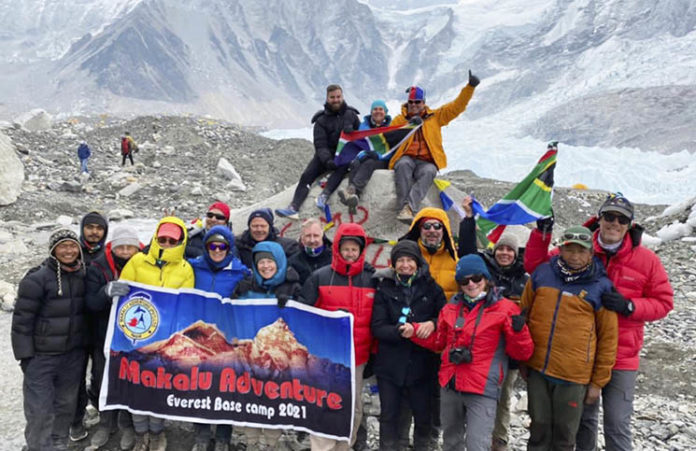
On 13 April a group of fifteen South Africans successfully reached Everest Base Camp despite the global Covid pandemic. For Prof Sonia Human, Rose Mills, Marius Fourie and John Thöle from Somerset West, Emily Farrell, Rory and Linda Macfarlane from Stellenbosch, Group leaders Klasie Wessels and Sue Pearson also from Stellenbosch, and Devin Baird from Cape Town, this was a trip of the lifetime and a life changing experience.
“Arriving in Kathmandu, the capital of Nepal, we were drawn into a different reality by the sight of wandering Sadhu’s (Hindu holy men) and open cremations on the banks of the Baghmati river. Our group had arrived the previous afternoon on a Qatar flight from South Africa and was spending the day doing some sightseeing, getting ourselves ready for the daunting flight to Lukla from where we will start our trek to Everest Base Camp.
Kathmandu is a shopper’s paradise – that is if you are interested in hiking, climbing, music and books. All at prices wishing you came with an empty suitcase. The Thamel area most frequented by western travellers is packed with interesting pubs, restaurants and shops selling hiking equipment, clothes, books, and local art. It was impossible not to get swept away by the energy and introduced to the Nepali culture which showed itself in so many interesting ways.
Our trek to Everest’s base camp was not merely a physical trek. It had the secondary benefit of being a discovery of personal heights as well. A place like Nepal, and the Himalayas in particular, is the most perfect setting for personal discovery. One is constantly challenged on all levels of one’s humanness; physically, mentally, and spiritually, and encouraged to discover new levels of self-awareness.
Overnight accommodation is in teahouses located in small villages dotted along the way – these mountain hamlets offer clean accommodation and basic food for all the trekkers and climbers along the way to Everest. The total walking distance from Lukla to Everest base camp is 65km. One typically walks for five to six hours per day and altitude is more important than distance. The thin air makes even the shortest distances a difficult task. Everest Base Camp at an altitude of 5 363m has 50% less oxygen than at sea level. In terms of fitness, one needs to be fit enough to walk for five to six hours per day for fifteen consecutive days.
On the morning of 7 April, we left for Lukla, voted “world’s most dangerous airport”. At an elevation of 2,800 meters above sea level the air in Lukla was cold, misty, and strangely fresh. Our spirits were high as we set off in the mist to Phakding, our stopover for the first night. The trek to EBC was scheduled to take us eight days which included acclimatization days in Namche Bazaar and Dingboche. Namche is a beautiful mountain village situated at 3,440m above sea level.
There are no roads on the way to Everest and this region is only accessible by foot or helicopter. After spending two nights at Namche, the journey really got tough and we had to deal with the typical challenge’s altitude bring such as diarrhoea, nausea, headaches, and dehydration.
We entered a different kind of discussion and started comparing notes on what was important to us, why we are doing this, what strengths we had to carry on through and what responsibilities we had to others whose dreams and hopes were with us. Faced with a real physical challenge, our conversation reached new levels of authenticity and we continued to form an ever-strengthening bond between ourselves amidst our sore tummies, aching heads, and general discomfort. The group continued for 2 more days and on 13 April successfully made it to Everest base camp at 5,350m.
Back in SA the photographs keep the dream alive and link us with a most unusual journey. It is not only an external journey to the highest mountain in the world, but also an internal journey to high points within yourself. Streetschool specializes in taking people on amazing adventures as part of personal development. The concept with this type of travel is to mirror the external journey with an internal one. By adding an internal discovery to the journey, the traveller receives so much more as was shown by this expedition to Everest.
When one goes on a journey like this, you don’t come back quite the same. New thoughts linger and serves as reminders to continue your own personal journey of discovery,” – Klasie Wessels, Streetschool.