Domestic workers make everyday life possible for millions of South African families. They are woven into our routines, our schedules, our peace of mind. They are there in the rush before school, in the quiet moments of care, in the steady rhythm of homes that run smoothly because someone is showing up, day after day.
And yet, because this work happens behind the closed doors of private homes, the workers often go unseen.
We see the tidy kitchen, the folded washing, the calm after a busy week. We do not always see the labour that made it possible. Domestic workers look after what matters most: children, homes, gardens, elderly parents. Their work quietly underpins family life and, in many ways, the broader economy. When households function, people can go to work, build businesses, pursue opportunities.
Here is the part we sometimes forget. When you employ someone to work in your home or garden, your private space becomes a workplace. It still feels like your home. It is your sanctuary. Yet legally and ethically, it is also someone else’s place of work. Over time, domestic workers may feel like part of the family. That closeness can be genuine and meaningful.
Yet even in close relationships, rights do not disappear.
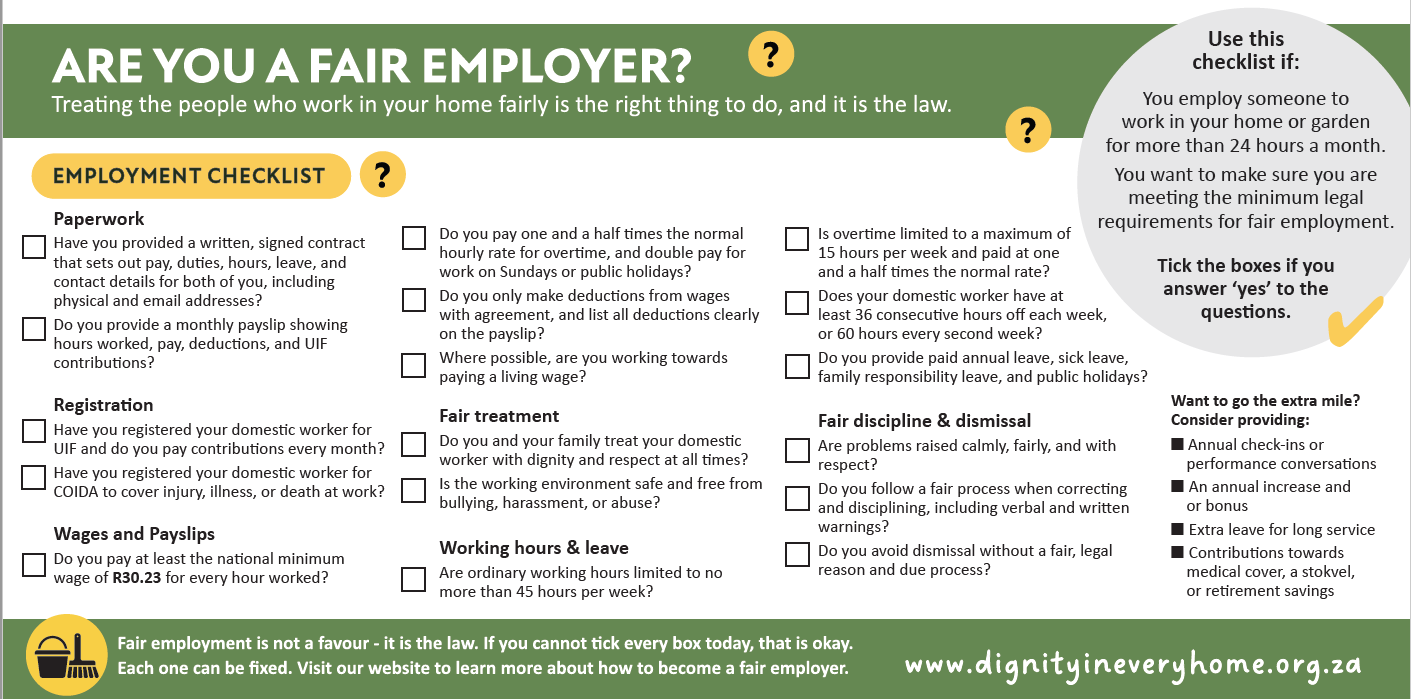
Over a cup of coffee, it is worth asking a simple question: are you meeting the minimum standards of fair employment?
That means minimum wages. Written contracts. Paid leave. Limits on working hours. Protection against unfair dismissal. Registration for UIF. Cover under COIDA if someone is injured while working in your home.
These are not nice gestures. They are legal standards. And because you employ them, the responsibility rests with you.
The good news is that this is not about becoming a legal expert. It is about clarity. When expectations are clear, relationships are healthier. A written contract prevents misunderstandings. A payslip builds transparency. Proper leave ensures rest and prevents burnout. Registering for UIF and COIDA creates a safety net if something goes wrong.
On a practical level, getting it wrong can have consequences: back-pay claims, CCMA disputes, fines, stress you never anticipated. Getting it right builds trust and stability. It protects both of you.
This is where Dignity in Every Home comes in. Our aim is simple: to raise awareness about domestic workers’ rights and employers’ responsibilities in a practical, accessible way. To make the basics clear, so that every home that employs someone can meet the standard the law requires.
Dignity in Every Home would like to encourage you now, to ask yourself a few straightforward questions:
Do you have a written contract in place?
Are you paying at least the legal minimum wage?
Have you registered for UIF and COIDA?
Are working hours and leave properly managed?
Are your accommodation and house rules for live-in workers up to standard?
If the answer to these and others basic employment standards is yes, then you are contributing to something bigger than your own household. You are helping to raise the standard of domestic work across the country.
If the answer is no, it is time to make some changes. To fix the gaps before they become real harm.
Domestic workers carry our homes in ways that often go unseen. The law simply recognises what should be obvious: this is real work, done by real people, with real rights.
Your home may feel private. But when someone works there, it becomes shared ground.
And shared ground comes with shared responsibility.
If you would like to find out more about Dignity in Every Home visit:
https://dignityineveryhome.org.za/
and follow us on:
Facebook: https://www.facebook.com/dignityineveryhome
Or
Instagram: https://www.instagram.com/dignityineveryhome