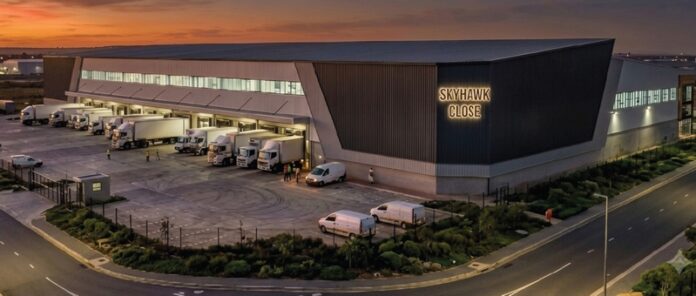
The Cape Town industrial property market has entered a notable new phase. Driven by sustained occupier demand, years of strong rental growth, and a severe shortage of well-located land, real estate developers are accelerating speculative development—building high-spec industrial facilities without securing tenants first.
This marks a major departure from how the metropole’s market has traditionally operated. For years, speculative industrial development remained limited as developers sought to minimize risk by securing tenants or developing for owner-occupier operational needs before commencing construction. Outside of a handful of established market leaders, few developers were prepared to build without a lease in place.
Today, however, sustained occupier demand, several years of strong rental growth, and a shortage of well-located industrial space have fundamentally reshaped the development landscape. Developers are committing capital and starting construction on the expectation that the market will absorb the new space.
Rental Growth Reshapes the Equation
Demand for warehousing and logistics space accelerated following the onset of the Covid-19 pandemic, supported by changing supply chains and the growth of e-commerce. At the same time, years of limited speculative development left the Cape market with constrained supply in many established industrial nodes.
Cushman & Wakefield | BROLL’s analysis of asking rentals at leading A-grade industrial parks shows the clear impact of these conditions:
- Gross Rental Growth: Asking gross rentals that were around R60/m² five years ago are now in the region of R90/m² to R95/m²—representing increases of as much as 58% since Q2 2021.
- Net Logistics Rates: Premium new logistics warehouses are currently commanding net rentals of R105/m² to R115/m².
In this positive cycle, it makes sense for well-capitalised developers and funds to progress developments on land holdings on a speculative basis to accelerate returns, rather than waiting for a typical RFP process that causes a cash drag on land.
Building for a Broader Market
Because speculative builds are not bespoke to a single tenant, versatility is crucial. Developers are designing facilities to accommodate as broad a range of occupiers as possible across a wide range of unit sizes:
- Unit Sizes: Schemes range from smaller facilities of around 500m² up to approximately 5 000m², with designs allowing adjacent units to be combined for larger occupiers.
- Adaptability: While the primary focus remains storage and distribution, scope exists to adapt office components, loading doors, and internal configurations. Highly specialized industrial users will still require custom facilities, but well-designed speculative stock offers necessary flexibility for broader warehousing needs.
Finite Land and Buoyant Capital Markets
Activity is spread across the Metropole wherever suitably zoned land, viable pricing, and major transport access align. However, well-located land remains constrained, and high acquisition costs make complete “brownfields” redevelopment of obsolete stock difficult to justify.
Meanwhile, capital markets mirror this occupier strength. Sales of premium warehousing have achieved yields between 8% and 9% (with select assets trading sub-8%), while older, good-quality space trades at 9% to 9.5%.
For local occupiers, this growth in speculative development offers faster access to modern A-grade facilities without the lengthy lead times of purpose-built developments.