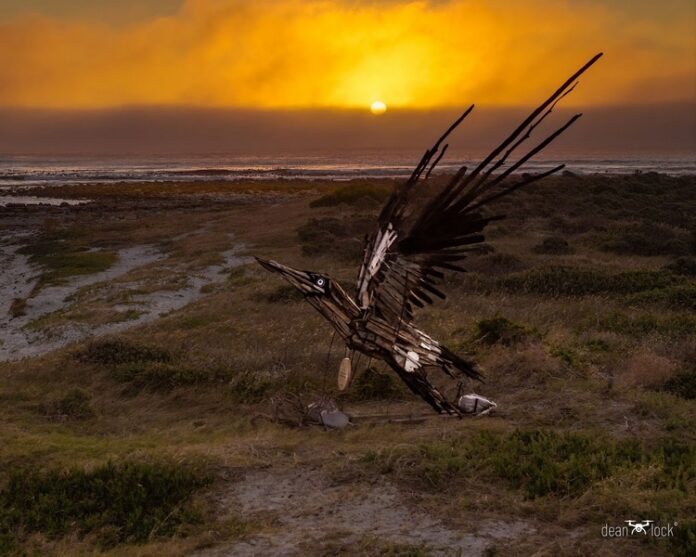
A five-metre-tall Cape Gannet now towers over the West Coast landscape, its wings stretched wide, its body shaped from driftwood and steel, and its presence impossible to ignore. Weighing close to 90 kilograms, the sculpture — known as Koos Malgas — is not just a feat of craftsmanship, but a powerful symbol of what South Africa stands to lose as mining accelerates along one of its most fragile coastlines.
Commissioned by the non-profit Protect the West Coast and created by Kommetjie-based artist Chip Snaddon, the sculpture draws attention to the growing threats facing the region’s unique ecosystems, wildlife and communities.
Art Born from the Coast
Koos Malgas is constructed from four removable sections — head, body and two wings — built around a welded steel skeleton and clad in driftwood collected over many years. As the wind moves through it, the sculpture creaks and sways, echoing the raw, untamed environment it represents.
For Snaddon, the materials were as important as the form. By using driftwood shaped by sea and time, the artist sought to mirror the vulnerability of the natural world.
“I wanted the sculpture to feel as though it belongs to the coastline,” he explains. “It should look like it’s always been there — but also like something that could easily disappear.”
A Coastline Under Pressure
The West Coast is one of South Africa’s most biodiverse and culturally rich regions. Its dunes, estuaries, kelp forests and beaches support small-scale fisheries, ancient cultural heritage and more than 6,300 endemic plant and animal species found nowhere else on Earth.
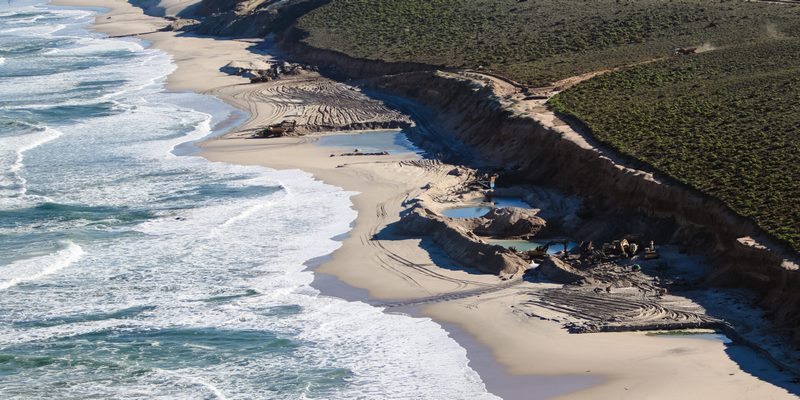
Yet this abundance is under severe threat. Nearly 88% of the coastline between Elands Bay and the Orange River mouth is now under mining or prospecting rights. Only around 10% of this stretch enjoys formal protection, leaving vast areas exposed to mineral and heavy diamond sand mining.
Environmental groups warn that the pace of development far exceeds what the region’s ecosystems can endure.
A Symbol of What’s at Stake
For Protect the West Coast managing director Mike Schlebach, Koos Malgas captures both the fragility and richness of the region.
“It’s a reminder of what we stand to gain if we protect and nurture these wild spaces,” he says. “This creature feels alive, as if it has always belonged here — which makes the threat of losing it all the more real.”
The sculpture stands as a visible marker of a coastline approaching a tipping point, where unchecked extraction could permanently alter landscapes that have taken millennia to form.
More Than a Sculpture
Koos Malgas is not just public art — it is a conversation starter. It invites visitors to pause, look up, and reflect on the delicate balance between development and preservation. In doing so, it asks a simple but urgent question: what kind of coastline do we want to leave behind?