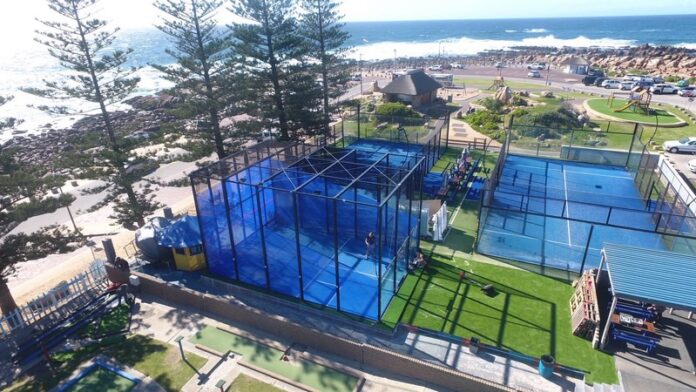
Perched right on the shoreline at The Point in Mossel Bay, Africa’s first permanent outdoor squash court is pulling a traditionally hidden sport into the Garden Route sunshine.
For decades, squash has suffered from a visibility problem. Tucked away behind the brick walls of private clubs, the sport has remained largely out of sight—and out of mind—for the average passerby.
Now, along the sunlit coastline of Mossel Bay, a striking blue-glass structure is quite literally shattering those walls.
Installed at The Point, one of the Garden Route town’s most popular oceanfront hubs, the facility is South Africa’s first outdoor squash court and the first permanent court of its kind on the continent. Built beside existing padel courts with panoramic views of the Indian Ocean, it offers a blueprint for how a traditional sport can adapt and thrive in the modern lifestyle era.
From Private Clubs to Promenade Culture
Former South African National Champion JP Brits spearheaded the planning and installation of the modular Access Courts facility. Choosing Mossel Bay over larger squash hubs like Cape Town or Johannesburg was a deliberate move aimed at pure foot traffic and public curiosity.
During the December–January festive season, Mossel Bay becomes one of South Africa’s top three holiday destinations, drawing up to a million visitors—and The Point sits at the heart of that bustle.
“The only other way of seeing squash is you have to go to a squash club,” Brits explains. “Whereas now, you’re just a normal person buying an ice cream and you walk past the squash court and you see people play. Hopefully, that will get people to want to play.”
At night, the court’s glowing blue glass stands out against the dark backdrop of the dock, turning fast-paced rallies into public theatre. It mirrors a global grassroots movement already underway in Chicago’s Union Park, Australia, Ireland, and New Zealand to bring open-air courts into everyday public spaces.
Competing in the Padel Era
Part of the urgency behind moving outdoors comes from watching the explosive rise of social racket sports—most notably padel, which sits right next door to the Mossel Bay court.
“Older squash clubs are finding it difficult to compare with vibrant padel clubs that have a little coffee shop, music playing, and floodlights,” Brits notes. “We need to compete with that because that’s the market. I want to have kids be excited about playing squash.”
To hook newcomers immediately, Brits is pairing the outdoor setting with Squash 57—a beginner-friendly version of the game played with a larger, bouncier ball and a wider racket head. He compares giving a beginner traditional squash gear to handing a first-time golfer pro-level blade irons on a championship tee. Combined with sunlight, music, and ocean views, Squash 57 dramatically lowers the barrier to entry.
On the Road to LA28
The timing of Mossel Bay’s landmark court is especially significant as squash prepares for its long-awaited Olympic debut at the Los Angeles 2028 Games. If this glowing glass box by the ocean proves to be the magnet Brits anticipates, it could spark a wave of public installations across South Africa—turning casual holidaymakers into the sport’s next generation of players.
Squash vs. Padel — What’s the Difference?
Walking past the new facility at The Point, it is easy to spot both courts side-by-side—but while they share glass walls and a fast-paced vibe, they are two completely different games:
- The Court: Padel is split down the middle by a tennis-style net, with opponents facing each other. Squash has no net—players stand side-by-side in the same enclosure and hit the ball against the front wall.
- The Format: Padel is almost exclusively played as doubles (2v2), making it naturally social. Squash is a high-cardio singles (1v1) workout.
- The Gear: Padel uses a short, solid, stringless paddle and a pressurized tennis-style ball. Traditional squash uses a long stringed racket and a small, low-bounce rubber ball (though Squash 57 uses a bigger, bouncier ball to make rallies easier for beginners).
- How the Walls Work: In squash, hitting the front wall is the main objective. In padel, you hit over the net first, using the glass walls behind you like a backboard to keep a rally alive after the ball bounces.