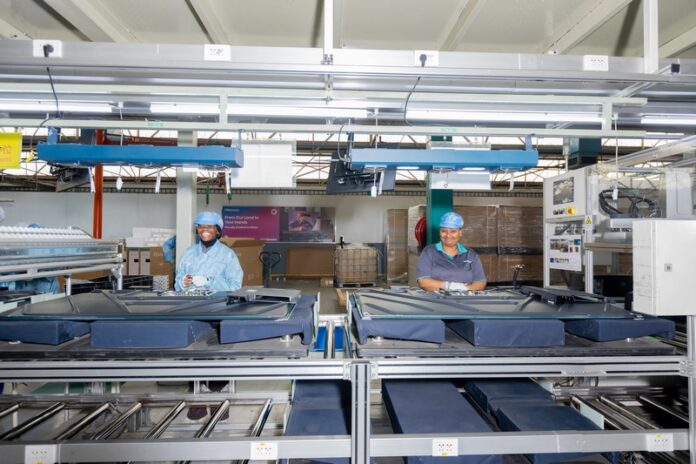
In October 1996, Hisense took a pivotal step by choosing South Africa for its first overseas subsidiary. Three decades later, what began as a commercial footprint has transformed into a cornerstone of South African electronics manufacturing. At the heart of this evolution sits the Hisense Atlantis Manufacturing Plant in the Western Cape, a facility that underscores the power of long-term investment, skills development, and industrial innovation.
Engineering Excellence and Global Scale
Established in 2013 through a R350 million joint investment with the China-Africa Development Fund, the Atlantis facility operates on an impressive scale. The plant holds the capacity to produce up to one million televisions and 500,000 refrigerators annually. By mid-2024, cumulative production reached approximately 4.5 million TVs and 2.9 million refrigerators.
Quality assurance remains central to the plant’s daily rhythm. “Quality assurance is built into the plant’s daily rhythm rather than treated as a periodic audit,” shares Luna Nortje, Deputy General Manager at Hisense SA. On the refrigeration lines, this includes daily performance checks, safety inspections, and monthly energy testing. This commitment to precision enabled the plant to begin exporting refrigerators to Europe in 2022, positioning South Africa as a key export base within Hisense’s global footprint.
Empowering People and Building Local Talent
Beyond assembly lines, the facility directly employs over 1,000 South Africans—primarily from Atlantis and neighbouring communities like Melkbosstrand and Mamre—with thousands more supported through supplier networks.
From day one, structured mentorship has paired Chinese technicians with local staff. The results speak for themselves: Hugh Stephens advanced from the production line to mainboard repair technician, Marlon Jacob rose from general worker to team leader, and Ayrton Minnies moved from the factory floor to lead a process technician team. At the plant’s 10th anniversary, Hisense honoured 98 employees who had been with the facility since opening day.
To expand pathways into employment, Hisense launched a fully funded learnership in September 2025 alongside EduPower Skills Academy, MERSETA, and W&RSETA. Offering hands-on production experience, the initiative recently graduated its first cohort of 100 unemployed youth, with 120 new learners already enrolled.
A Model for Reindustrialisation and Community Impact
Cited by the UN Office for South-South Cooperation and highlighted at the March 2026 Buy Local Summit, Atlantis serves as a benchmark for reindustrialising smaller towns.
“Localisation can’t only be measured by what comes off a production line,” says Nortje. “It has to be measured by the capability we leave behind; the people we train, the employment we create, the opportunities that become possible because manufacturing happens here.”
This philosophy extends across South Africa. Through its Hands on the Future programme, Hisense funds community sports equipment, educational visits to its Tevolution Museum, and technical training via the Hisense-Northlink Technical Academy. Meanwhile, its Loads of Love initiative donates washing machines and dryers to care centres, animal shelters, and hospitals nationwide.
Looking Ahead
As its local footprint grows—from its premium Canal Walk store to the July 2026 introduction of Toshiba TV—Hisense’s Atlantis plant proves that industrial manufacturing and community empowerment can thrive together.