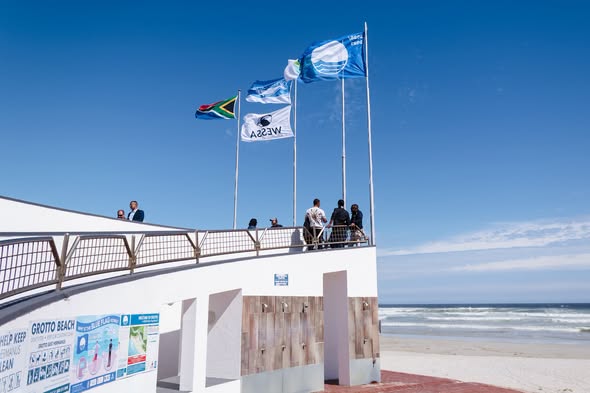
As South Africans prepare for the upcoming summer season, holidaymakers can look forward to world-class coastal experiences following the announcement of the 2026/27 national coastal awards in Hermanus. The Wildlife and Environment Society of South Africa (WESSA) officially recognised 62 Blue Flag sites and 19 Green Coast destinations during a landmark event co-hosted at Grotto Beach in Hermanus.
The awards mark a dual milestone: 25 years of the Blue Flag programme in South Africa—the first country outside Europe to implement the global standard—and WESSA’s own centenary celebration.
What the Blue Flag Means for Summer Holidaymakers
For local families, domestic tourists, and international visitors heading to the coast this summer season, a Blue Flag signals far more than clean sand. The eco-label guarantees that accredited beaches, marinas, and tourism boats adhere to strict international standards for water quality, public safety, professional lifeguard services, clean facilities, and environmental education.
A total of 50 full Blue Flag beaches, 20 pilot beach sites, 7 tourism boats, and 5 marinas were awarded certificates alongside 19 Green Coast sites, giving holidaymakers a clear guide to South Africa’s best-managed coastal spots.
25 Years of Unbroken Coastal Excellence
Maintaining Blue Flag status requires rigorous year-round monitoring and compliance. Three iconic South African beach destinations were specially celebrated for sustaining 25 consecutive years of continuous Blue Flag status:
Grotto Beach (Overstrand Municipality)
Humewood Beach (Nelson Mandela Bay Metropolitan Municipality)
Marina Beach (Ray Nkonyeni Local Municipality)
“We’re proud of that history, and we are conscious that that history comes with a huge responsibility to keep earning people’s trust and to respond to the challenges of our time,” said WESSA CEO Cindy-Lee Cloete.
Inclusivity at the Shoreline
A major highlight for coastal lifestyle and travel this season is the push toward universal access. The event featured the launch of the Living Coast Prototype Signage at Grotto East Beach. Developed in partnership with Blind SA and the National Council of and for Persons with Disabilities, the initiative introduces Braille signage alongside digital guides offering audio, subtitles, and environmental information in English, Afrikaans, and isiXhosa.
“A sign should not only be seen; it should be heard, felt, and understood,” noted Ryan Peter of the Department of Forestry, Fisheries and the Environment (DFFE). “That is what inclusive environmental education looks like.”
Looking Ahead: 100 Blue Flags by 2030
Representing the National Department of Tourism, Dr Shamilla Chettiar emphasized that ecological stewardship and tourism growth work hand-in-hand to support local coastal economies during the peak holiday period.
WESSA has set an ambitious target to expand the footprint to 100 Blue Flag beaches across South Africa by 2030, ensuring that as coastal tourism grows, the protection of fragile marine ecosystems remains the primary anchor.