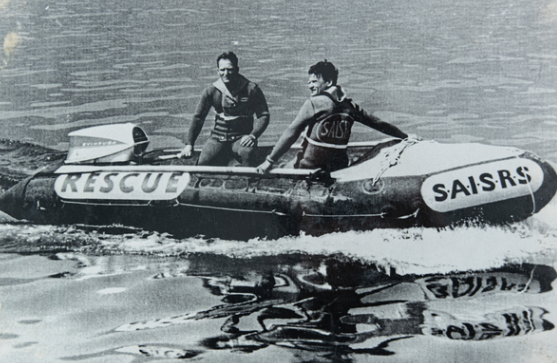
As South Africa gathers around the braai fires and honours its rich, diverse tapestry on 24 September, a uniquely South African institution is reflecting on its own legacy. This Heritage Day—which fittingly coincides with World Maritime Day—the National Sea Rescue Institute (NSRI) celebrates nearly six decades of ordinary citizens coming together to perform extraordinary acts on the country’s coastal and inland waters.
Born from Tragedy: A Legacy Sparked by Community Action
The NSRI’s story is a testament to the power of community action. It began not in a corporate boardroom, but in the tragic wake of a 1966 storm off Stilbaai, where three fishing vessels sank, claiming 17 lives. Moved by the disaster, Simon’s Town schoolteacher Patti Price—who had herself been rescued from a shipwreck in the English Channel as a child—launched a relentless letter-writing campaign demanding a dedicated search and rescue service for South Africa.
Her impassioned plea rallied the Society of Master Mariners, leading to the creation of the South African Inshore Rescue Service in 1967, which soon evolved into the NSRI.
“Heritage is not only what we inherit from those who came before us. It is also what we choose to carry forward,” says NSRI Chief Executive Officer Mike Vonk. “The NSRI’s story belongs to the thousands of volunteers who have answered calls for help, the donors who have made our work possible and the communities that continue to stand behind us.”
Putting Maritime Excellence into Practice Across the Nation
Today, as the organization prepares for its 60th anniversary in 2027, the NSRI’s footprint spans the entire nation. Operating across oceans, dams, rivers, and lakes, 1,431 operational volunteers across 43 stations in eight provinces responded to 1,069 operations and saved 1,548 lives in 2025 alone.
This year’s alignment with World Maritime Day and its theme, “From Policy to Practice: Powering Maritime Excellence,” highlights the NSRI’s role as an operational bedrock for South Africa’s maritime sector. Yet, saving lives today extends far beyond emergency response.
Beyond Rescue: Proactive Drowning Prevention
Over the years, the institute has pioneered proactive drowning prevention. Through survival swimming, beach lifeguarding, and water safety education, the NSRI reached more than 924,000 people across all nine provinces in 2025. Furthermore, its iconic Pink Rescue Buoys, installed at strategic water bodies nationwide, have directly saved over 260 lives since launching in late 2017.
Powered by People: The Volunteer Spirit of Mzansi
Despite its growth, the heart of the NSRI remains unchanged: it is powered almost entirely by the goodwill of the public. With over 97% of its funding coming from private individuals and corporate donors, the spirit of volunteerism that Patti Price sparked in 1967 remains as vibrant as ever.
“For almost 60 years, people from different communities, professions and backgrounds have come together around one shared purpose: saving lives,” Vonk adds. “That spirit of volunteerism and care for one another is an important part of our national heritage.”
As South Africans celebrate what makes the nation unique this Heritage Day, the NSRI stands as a beacon of selfless service—proving that when South Africans unite, they can weather any storm.