
How a cold Atlantic current and an abundance of sunshine combine to create one of the most unusual growing environments in the wine world.
Stand in the vineyards at Benguela Cove on a clear winter’s day and you will notice something unexpected. The sun is strong. The sky is open — no mountains to trap cloud, no valley shadow, just an unbroken stretch of light over the vines and the lagoon below. And yet the air coming off Walker Bay is cold. It is a combination that feels almost contradictory, and it is precisely what makes this estate unlike anywhere else in South African wine.
Cellar Master Johann Fourie has a name for it: cool-sunshine. It is Benguela Cove’s own term for a growing environment that offers both an abundance of UV-rich sunlight and a persistent cooling influence from the Atlantic Ocean and it is the terroir story that underpins every wine the estate produces.
The current that drives everything
The Benguela Current is one of the world’s major ocean currents, flowing northward for roughly 3,000 kilometres along the west coast of southern Africa and carries cold water from the deep ocean to the surface through a process called upwelling cold, nutrient-rich water rising to replace the warmer surface water pushed offshore by the wind.
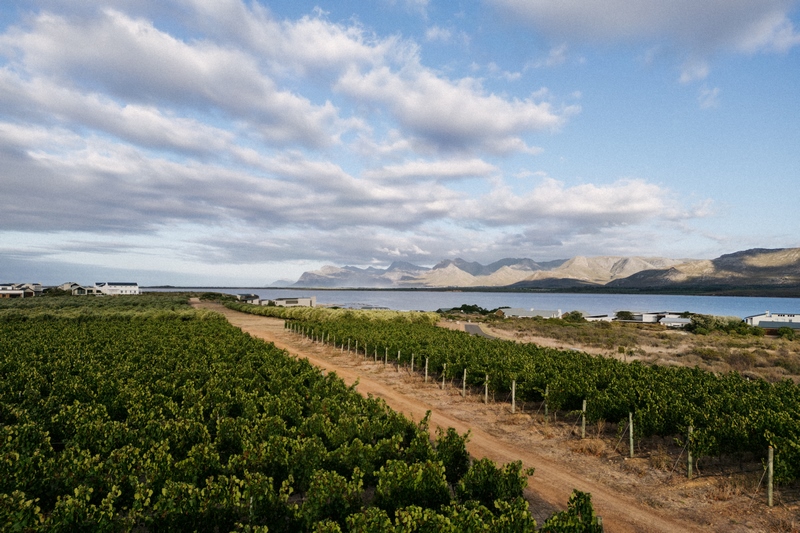
The cold ocean surface cools the air above it. That cooler air moves inland each afternoon as a strong south-easterly breeze, moderating temperatures across the vineyards throughout the growing season. During peak summer months, this maritime influence keeps median daytime temperatures 3 to 5 degrees Celsius lower than inland wine regions. The constant airflow through the vine canopy also improves air circulation around the grape bunches, reducing humidity and the risk of fungal diseases.
What the sun adds
Here is where Benguela Cove’s story diverges from the usual cool-climate narrative. The estate sits in an open coastal position, not in a valley, not against a mountain which means cloud cover is minimal and UV intensity is high. Sunshine hours are generous. And UV plays a specific role in vine development that is often overlooked in discussions of cool-climate winemaking.
UV exposure drives vines to protect themselves by thickening their berry skins and producing flavonoids. At Benguela Cove, these phenolic compounds stabilize colour, improve aging potential, and concentrate tannins—resulting in grapes with an intense depth unexpected for a cool-maritime site.
The combination matters: abundant sunshine drives flavour development and phenolic ripeness, while the Benguela Current moderates the heat that would otherwise strip acidity and delicate aromas.
A longer season, a more complete grape
The practical outcome of this environment is a longer and slower ripening season than most South African wine regions experience. Grapes at Benguela Cove accumulate sugar more steadily, reach optimal flavour development before harvest, and retain higher levels of natural acidity throughout. Tannins in the red varieties ripen fully while retaining the freshness that warmer climates tend to sacrifice. White varieties show enhanced citrus, floral, and mineral characteristics that are the hallmark of cool-climate viticulture.
Benguela Cove Lagoon Wine Estate, consistently ranked among the World’s Best Vineyards, sits directly on the shores of Walker Bay, with 70 hectares of vineyards experiencing this maritime influence throughout the growing season. The estate is a certified WWF Conservation Champion and is located within a UNESCO designated RAMSAR-listed wetland. The cold current that supports the whales in the bay below is the same force shaping the wine in the glass above.
For more information visit www.benguelacove.co.za